
Tata Motors will soon submit a detailed report on the upcoming manufacturing plant in Tamil Nadu's Ranipet district and a decision, on whether the facility will churn out passenger or commercial vehicles, will be taken by the company on the basis of market trends, state's industries minister TRB Rajaa said on Thursday. "They are keeping the options open, and market trends will determine it (the type of vehicles the plant will make). "They will quickly come up with a detailed report on that," Rajaa said.

"The retail prices have been raised in the range of Rs 7,000-12,000 across all the four variants," the company said.

Only five of India's top 20 car models have seen a reduction in wait times over the past year.
Having signed up teen tennis sensation Sania Mirza as brand ambassador for its Getz model, Hyundai Motor India on Monday

Indian automakers dispatched nearly 2.92 lakh passenger vehicles, the highest ever for February so far, driven by strong demand for cars and utility vehicles, industry body SIAM said on Friday. The total passenger vehicle dispatches from companies to dealers last month increased 11 per cent to 2,91,928 units from 2,62,984 units in February 2022. Passenger car sales rose to 1,42,201 units in February against 1,33,572 units in the year-ago period.

Reflecting the woes of the Indian automobile industry, the country's car exports remained flat at 550,466 units in 2013-14, during which domestic sales fell for the second consecutive year.

The company is banking on investments lined up for product development and other innovations.

The company currently sells various vehicle brands in the country ranging from hatchback Spark to sports utility vehicle Captiva, priced between Rs 333,000 and Rs 25.71 lakh (Rs 2.57 million), respectivley, (ex-showroom Delhi).

Of the 15 car manufacturing companies in India, eight have a market share of below 2 per cent, raising questions about their long-term future in a competitive market that has already seen Ford Motors and General Motors slam the door on India.
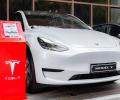
With India's EV penetration at just 2.5 per cent, the market presents an opportunity -- provided Tesla gets its pricing right.

Maruti Suzuki is offering cash discounts ranging from Rs 5,000 on its hatchback Celerio to Rs 35,000 on entry level Alto800.
South Korean auto giant Hyundai has inaugurated its first $1.1 billion factory in the North American market.\n\n

The MG ZS EV, to be unveiled next month, will go head to head with Hyundai Kona, launched in July this year as the country's first fully electric SUV.

Passenger vehicle majors like Hyundai, Tata Motors, M&M, Toyota Kirloskar and Honda on Wednesday reported growth in domestic sales in August riding on festive sentiments, although market leader Maruti Suzuki posted a decline amid a semiconductor shortage affecting the industry. The country's largest carmaker Maruti Suzuki India Ltd (MSIL) reported domestic sales at 110,080 units, as compared to 116,704 units in the same month last year, down 6 per cent. "Sales volume of the company in August 2021 was affected due to electronic components shortage.
Hyundai Motor India on Wednesday increased the prices of its mid sized sedan Accent by up to Rs 9,000 and the premium hatchback Getz by up to Rs 7,000 across variants with immediate effect.
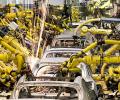
Indian automobile units are employing more and more robots to improve your car's efficiency. India is catching up well as world over, the latest technologies is redefining outdated manufacturing processes.

It plans to increase India sales by a tenth, helped largely by launches next year

Passenger vehicle wholesales in India rose by 14.16 per cent in August to 2,15,916 units, driven by pent-up demand, industry body SIAM said on Friday. According to the latest data by the Society of Indian Automobile Manufacturers, passenger vehicle wholesales stood at 1,89,129 units in the same month last year.

Maruti Suzuki India (MSIL) - the market leader in small cars - is eyeing the top spot in the sports utility vehicle (SUV) segment within a year - with a 33 per cent share of the pie. The company has been selling two SUVs - the Brezza and the Grand Vitara - and will start deliveries of the Jimny and the Fronx from March-end, and has set a target of growing its share from the current 11.5 per cent of the SUV market to 33 per cent by the end of 2023-24. The SUV segment is roughly about 42 per cent of the total passenger vehicle market, or around 1.3 million units.

The global semiconductor shortage hit passenger vehicle sales in September, with major manufacturers like Maruti Suzuki, Hyundai and Mahindra & Mahindra reporting a decline in sales on Friday. Kia India and Honda Cars also reported a dip in wholesales last month as compared with the year-ago period. Carmakers like Tata Motors, Toyota Kirloskar Motor, Nissan and Skoda, however, reported an increase in passenger vehicle dispatches last month despite supply chain issues.

Auto Expo 2023 may not trigger a fresh rally in automobile stocks, say analysts, as this year's edition lacks participation from major listed players. It is also owing to the focus on electric vehicles (EVs), a segment where four-wheelers have minuscule market share. "In the passenger vehicles (PV) segment, Maruti Suzuki India and Tata Motors are the only listed players.

India's electric mobility goal, which has so far been riding on two wheels, is all set to graduate to four wheels. At least, the journey has begun. Hyundai Motor India said it would invest Rs 4,000 crore till 2028 to launch half-a-dozen electric vehicles (EVs) in India. It would eventually straddle premium and mass segments. The first of these - the electrified version of an internal combustion engine (ICE)-powered model - will go on sale as early as next year.

The industry needs stimuli to help revive consumer demand and conversions.
While sales of compact cars, including models such as Swift, Celerio, Ignis, Baleno and Dzire declined, sales of utility vehicles, including Vitara Brezza, S-Cross and Ertiga, increased 26.3 per cent to 19,177 units as compared to 15,178 in the year-ago month.

Reflecting the mood, passenger vehicle sales in November either remained muted or skidded for most manufacturers as high fuel prices and the higher cost of borrowing dampened buying sentiment.

During May, Maruti Suzuki's domestic car sales were up 2.59 per cent at 87,402 units as against 85,190 units in the same month last year.
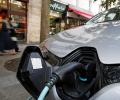
Automobile manufacturers, new and old, as well as ancillary suppliers are set to spend a combined Rs 70,630 crore over the next five years on either entering the electric vehicle segment or stepping up their presence in it. Data culled from announcements made by firms shows India, the world's fifth largest automobile market, is poised to receive one of the biggest capex pushes ever to fuel the transition from internal combustion engines to electric motors and batteries as part of a green drive. The EV push, egged on by the government's emphasis on electric mobility to meet its net zero targets, is expected to yield at least 25 electric vehicles - new ones as well as electrified versions of existing vehicles running on internal combustion engines.

Maruti's sales of the compact segment comprising Swift, Estilo, Ritz, Dzire and Baleno went up by 9.9% to 45,579 units
Hyundai Motor India on Friday hiked prices of its premium small car Santro by Rs 10,500 to Rs 12,000 with immediate effect, company sources said.\n\n\n\n

A long and bitter funding winter in the start-up world is beginning to take its toll on start-up advertising across properties. Earlier this week, Mastercard replaced Paytm as the title sponsor for all international and domestic cricket matches organised by the Board of Control for Cricket in India (BCCI). But this is just one part of the story. The other side is that organisers of high-impact shows and events on Hindi general entertainment channels, too, are feeling the winter chill.

What worked for Hyundai in India when so many other auto manufacturers have had to eat humble pie? Pavan Lall finds out.

The challenges of transition to stricter emission norm BS-VI from BS-IV and compliance to new safety norms thereby making vehicles costlier are lurking around the sector.

Even as India's passenger-vehicle sales touched a record high of 3.9 million units in 2022-23, growing 27 per cent over the previous financial year, the country's largest carmaker, Maruti Suzuki India (MSIL), said on Monday uncertainties in the electronic-component supplies might affect production in FY24. MSIL said the shortage of electronic components had some impact on production in FY23. "The company took all possible measures to minimise the impact.

The company is planning the despite facing continued pressure on sales.

First-time buyers of cars and sport utility vehicles (SUVs) have made a comeback, shows last year's data from top passenger vehicle (PV) makers. If the trend persists, it may move the needle on the overall car penetration ratio. India's car penetration ratio is 32 per 1,000 people - one of the lowest, compared to mature car markets like the US and Europe.

The compact segment where Sonet will be launched is crowded with the Maruti Vitara and Brezza, which top the sales' list, and a bevy of models from Mahindra & Mahindra apart from Hyundai's offering. But volumes in this are slightly higher than those in the mid-segment, making it attractive, says Surajeet Das Gupta.
.jpg)
The compact segment makes up for nearly 25 per cent of car sales in India.

Tamil Nadu is leaving no stone unturned in marketing its upcoming global investors meeting on January 7 and 8. While business veterans are promoting the positives of the state's industrial climate through the 'Titans of Tamil Nadu" campaign, the state is narrating the human stories behind its robust industrial growth via the 'One Trillion Dreams' campaign. Among the industry bigwigs, who are showcasing Tamil Nadu to the world through this mega marketing initiative include Venu Srinivasan of TVS Motor Company, K M Mammen of MRF Ltd, Pratap Reddy of Apollo Hospitals, P R Venketrama Raja of Ramco Group, Mallika Srinivasan of TAFE; and Vellayan Subbiah of Murugappa Group.
